September 11, 2026 · Hexagon Intergalactic
Purkutaide 2026: Immersive LED iceberg audiovisual installation
What Was Left Unsaid - Building a glowing LED iceberg in an exhibition space

I had a dream where I was swimming underwater in a lake at night. I looked up and saw the bottom of a large rowboat, dark and shimmering, silently floating above me. There were lights glimmering across its surface. It was eerie, and when I woke up, the thought of a large thing descending from a ceiling kept haunting me. Being beneath the surface, looking up at something like that, felt surreal and ominous. I knew I wanted to do something with the idea.
A week or two later, my friend Elina, a hardworking VJ who goes by Mikrovision, came to my house for a weekend. We were supposed to have a visual LAN party for two, projecting visuals onto some finished artworks on my workshop wall and just play around with lights and see what we come up with.
I picked her up from the train station at six in the evening, explained the idea and asked whether she was interested in making an installation for Purkutaide 2026. She said she was very interested.
I told her the application deadline was in six hours.
From a boat to an iceberg
We've built all sorts of installations since 2013 in all sorts of venues, sometimes on very short notice. Improvisation, quick thinking and pushing hard when it matters have become some of our strengths. I would almost say that's our comfort zone at this point.
Thanks to Elina, the idea very quickly evolved into an iceberg. An actual semi-transparent, glassy-looking iceberg, with pixel-mapped lights inside it. Lightning and colour vortices rumbling beneath the ice.
We went back and forth for a bit about how literal it should be. We could take the idea of an iceberg and go wild and conceptual with it, or try to make the thing as realistic as we could. We settled on the latter. This was going to be an intimidating project, which I liked a lot.
Elina made a test model right away in Blender using our rough dimensions, and I 3D-printed it. We also laser-cut a couple of MDF slabs, drilled holes in them and pushed some WS2811 pixels through. That gave us a first look at the lights and a way to try out the kind of visuals we might want to run.
Wire, glue and garden fleece
The skeleton was made from two-millimeter steel wire, with thinner wire tying the pieces together. Initially we wanted large polygons across the surface, like cracked ice. Finding a material for that surface took much more work than the electronics.
We tried fibreglass, polyurethane lacquer, polyester resin and all sorts of combinations before landing on water, PVA glue and frost fleece. That's the thin fabric you put over plants outside to protect them from freezing.
It worked so well that we were delighted to skip the fumes of most of the other materials we'd been trying. The fleece gave us a milky, diffusing surface for the LEDs, while still letting enough light through. Getting the thickness and transparency right was the difficult part. The whole effect depended on it.
All the high-tech stuff, like the LED mapping and electronics, was easy by comparison. We spent about a week testing materials and making mock-ups in my workshop, followed by three weeks working in the exhibition space. There was then a six-week gap before the exhibition opened to the public in mid-May.
A room we could work with
We missed the initial day of picking rooms, but fortunately Jouni had kept one for us, and it was absolutely spot on: five by five meters, with no awkward things on the walls to hide and good space overhead for hanging the work.
The building is due for a major overhaul after the exhibition. That's the idea behind Purkutaide, and it gives you quite a bit more freedom than you usually have in a gallery. Drilling into the walls and stone ceilings was something we could actually do as we liked, with help and equipment from the crew.
For a while we considered putting seabed-like scenery on the floor and walls. In the end we went with black molton, the thick theatre fabric, and a dark floor and ceiling. The glowing iceberg would have all that darkness around it. I especially liked that we were making something large that neither stood on the floor nor hung against a wall. It was already a strange object before we even put the lights on.
At first we built a wooden square frame, added some corners, then drilled some holes into the frame and pulled the 2mm wire through it many times around the frame. After we had secured the frame to the ceiling, these wires were then woven into a low-polygon like shape for the iceberg.
When we finished the weaving and tied the nose together, it suddenly got a lot stiffer than before. That stiffness allowed us to flip it again reversed to look like a mountain. We could then layer on these frost fleece fabric pieces wet with water and PVA glue. Do this with enough layers and you will start to see depth in the diffusion of the fabric. We put a light inside the iceberg so we would be able to see the thickness of the fabric when circling around it.
After a while, with multiple layers of the garden fleece already laid on, we decided that we need to start judging the thickness of the ice with actual LEDs to get a realistic picture of how the thing will actually look like. Our first tests confirmed: We were getting close with the correct thickness.
The visitor experience
You enter through a curtained doorway. You look up at this huge, glowing iceberg hanging from the ceiling. The ice seems to have depth, with colours moving beneath its surface. Sometimes they move slowly, sometimes they whizz past.
There are two large sofas in one corner and beanbags opposite them. It's fairly obvious that you're welcome to stay for a while. Strange, bubbling sounds and what sound like spaced-out guitars move around the room.
Then there's a crack, and whispers and odd, floating thoughts fill the space. Those sounds are coming from inside the iceberg.
The wider exhibition has some very strong themes and messages, as you might guess from its name, “This is what I want to say”. Our room is at the end of a long exhibition hall, so for many visitors it's one of the last installations they see. There's a lot to take in before they get there. We wanted this to be a bit of an oasis, a palate cleanser at the end of the hallway.
The mood in the room isn't always peaceful and harmonious. There's a lot to the concept of the things that have been left unsaid. Sometimes the thing we decide not to say may end up being the only thing you can see. We wanted to give people a moment to think about what was left unsaid.
Space guitars and cracking ice
We were originally going for something more sinister. The direction changed when Ville Miettinen started working on the soundtrack, and we loved where he took it.
His first version was about fifteen minutes long. We liked it a lot, but wanted something calmer and more serene, with two separate tracks playing simultaneously. After a bit of back and forth, he caught on to the idea and really got into the project.
He played space guitars through vibraphone tubes with a friend, went to a nearby pond to record the ice cracking with a hydrophone, and did all sorts of magic to the soundtrack. In the end he emerged from the studio with two forty-minute tracks: one for outside the iceberg and one for inside it.
The result isn't pure bliss and relaxation. It's still haunting, uneasy and off-kilter at times, which I like. We hadn't lost the strange feeling that got me interested in the first place.
Sound from inside the ice
Purkutaide supplied four smaller Cepter speakers for the room and two larger six-inch studio monitors for inside the iceberg. Having a separate track coming from inside the sculpture gave it a lot of dimension. You could hear the sound floating around the room, but also hear something happening within the thing above you.
I initially made a small application called Droner to handle playing different tracks through different audio devices. I've since merged that functionality into Filament, where mixer tracks can be routed to separate devices as well.
For the hardware, we used a few active USB-C-to-3.5 mm adapters. The computer sees each of those as a separate audio device, so we could send the tracks to different sets of speakers.
Half an hour of mapping
There are eight LED strings inside the iceberg, with WS2811 seed pixels spaced 2.5 centimeters (1") apart. They start from eight different sides, spiral inward and then go back and forth more or less however they want.
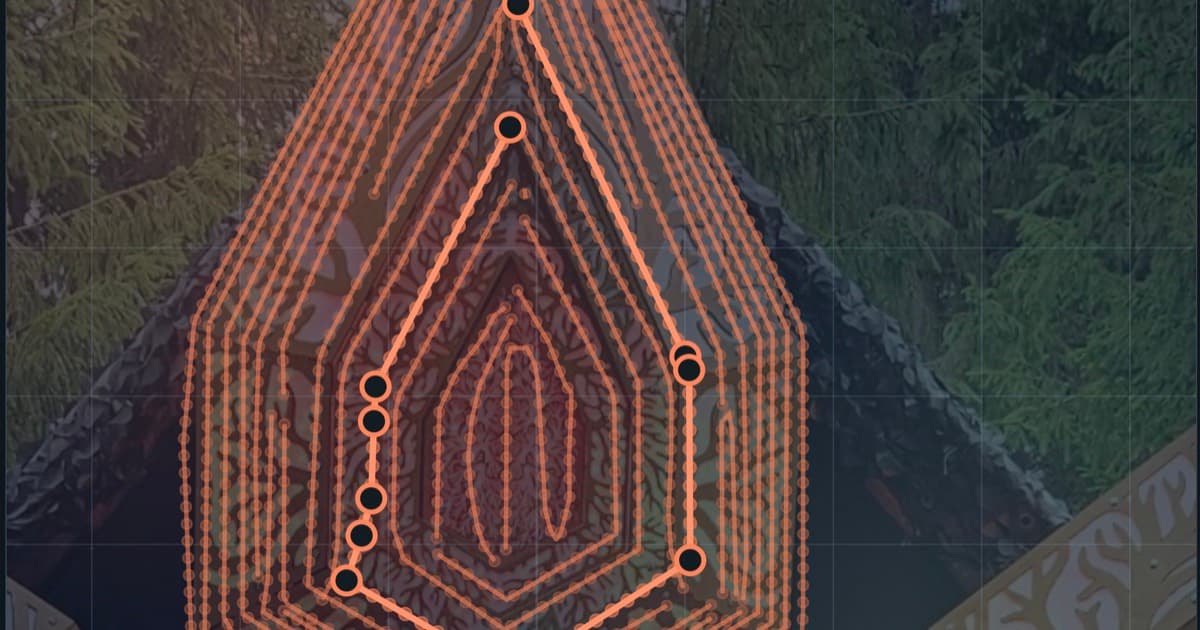
That wasn't a problem for the mapping. We turned the iceberg on its side and I took a photograph looking into it. I brought that into Filament and traced the LEDs a short section at a time. The whole mapping process must have taken maybe thirty minutes.
The tip of the iceberg sits in the middle of the mapped image. That arrangement let us work with swipes and polar-coordinate patterns, sending colour around the iceberg from that central point.


The box behind the fabric
There's a black box in the corner of the room, hidden behind the molton, with a Mac Mini M1 running Resolume and Filament.
Resolume has a couple of layers of video clips on random autopilot. It sends the video to Filament over Syphon, and Filament maps it onto the LEDs. From there the pixel data goes through a network cable to a twelve-port controller, which drives the eight strings inside the iceberg. The clips keep changing in slow, unpredictable ways. With the new Filament, we could have easily done this entire thing without Resolume.
Runs unattended for months
The setup has been running around the clock for the months since the exhibition opened. Our one recurring software chore has been connecting Resolume to the internet once a month so it doesn't start showing the watermark. With just Filament this wouldn't be an issue.
We've also set things up to resume after a power cut. There is one annoying exception: the Cepter speakers. They always come back with the power switched off and need to be turned on with the remote control. The rest of the setup can recover, but those speakers still need someone to go and press the button.
A bit of a brain rinse
People have been lying on their backs under the iceberg. Quite a few have told us how relaxed they felt sitting on the sofa, watching the colours move and listening to the soundtrack.
That's very close to what I hoped the room would do. You sit down for a moment and end up in your own thoughts for much longer than you planned. When you leave, it's like your brain has been rinsed.
I like that there's still something a little uneasy about the iceberg while people are having that experience. The original dream was eerie, and we kept some of that feeling even as the room became somewhere to relax.
The camera doesn't really get it
This thing is very hard to photograph. The room is black, there are three UV LED bars, and the iceberg almost always looks fuzzy or out of focus in pictures. The depth that makes it work in person is difficult to get across.
The sound is just as awkward to capture. A microphone doesn't easily convey those two tracks playing from different places, with the sound moving around you and coming from inside the iceberg.
It's really a space you need to experience yourself. The pictures don't quite show how mesmerizing it is in person.

Getting it back through the door
You could probably make something good with much less effort. We really wanted to push it, though, and put in the work to make the iceberg as realistic as we could. I think we succeeded pretty well. The surface was a lot of work, but that's also where so much of the effect comes from.
What happens to it after the exhibition is still a bit of an open question. I'd like to keep it together somehow. I'm wondering whether we could roll it in on itself enough to get it out through the doorway. Once it's out of the room, we're golden: there are large lifts, and the rest should be much easier. We might have to do something drastic to get it through that first door, though. I don't yet know what it will look like afterwards.
Or maybe the artwork itself is just as ephemeral as the exhibition itself. We'll see in October!
We made the installation with Mikrovision, with the soundtrack by Ville Miettinen. Thanks to Jouni and the Purkutaide crew for all of the help, equipment and excellent company. You guys rock. ❤️
Wrapping up
I've also written up an article on how I build my waterproof WLED controller boxes, with the parts list, wiring and settings.
And if this got you thinking about something you'd like to make, download Filament and try it with your own lights. It's the same software I used to map and run the show. I'd love to see what you do with it.
installation · behind-the-scenes · led-mapping