July 28, 2026 · Hexagon Intergalactic
Kosmos Festival 2026 Spacetime Stage build report
Five laser cut plywood crystals, 7,000+ WS2811 pixels, two stacked 8.5K projectors, three nights in a Finnish forest.

My name's Heikki, I've made lasercut LED artwork in Finland now for over 10 years under the name Hexagon Intergalactic. Our art collective KIVA has been producing the Spacetime stage at Kosmos Festival in Finland for the last four years.
This July we built a completely new layout: five crystals, laser-cut plywood artwork with over seven thousand WS2811 pixels built into them. Every one of those pixels was driven by Filament.
This is a festival deco report: the build, the hardware, the mapping, the show nights.
The stage
Kosmos Festival is Finland's legendary psytrance festival. Five stages, deep in the woods. This year marks 13 years of history for Kosmos, and it was the 5th year in a row that I'm working on this stage (2022 we ran the stage with Mikrovision with no projectors, just laser cut MDF panels with programmable leds). The Spacetime stage is secluded behind the bazaar area, kind of like a cozy pocket in the lush forest.
The triangular stage structure itself was built last year, after the old one was deemed not in good shape anymore. Max and Jonttu did solid carpentry work building this shrinking-triangles shape.
This year's deco was five plywood crystals across 8 meters of stage width, with over 7,000 WS2811 pixels between them, and a few thousand more in seed pixel strings in the stage environment. On top of that we had 2 × 8.5k lumen Panasonic projectors stacked for a ~17k lumen image over the whole stage.
The crystals
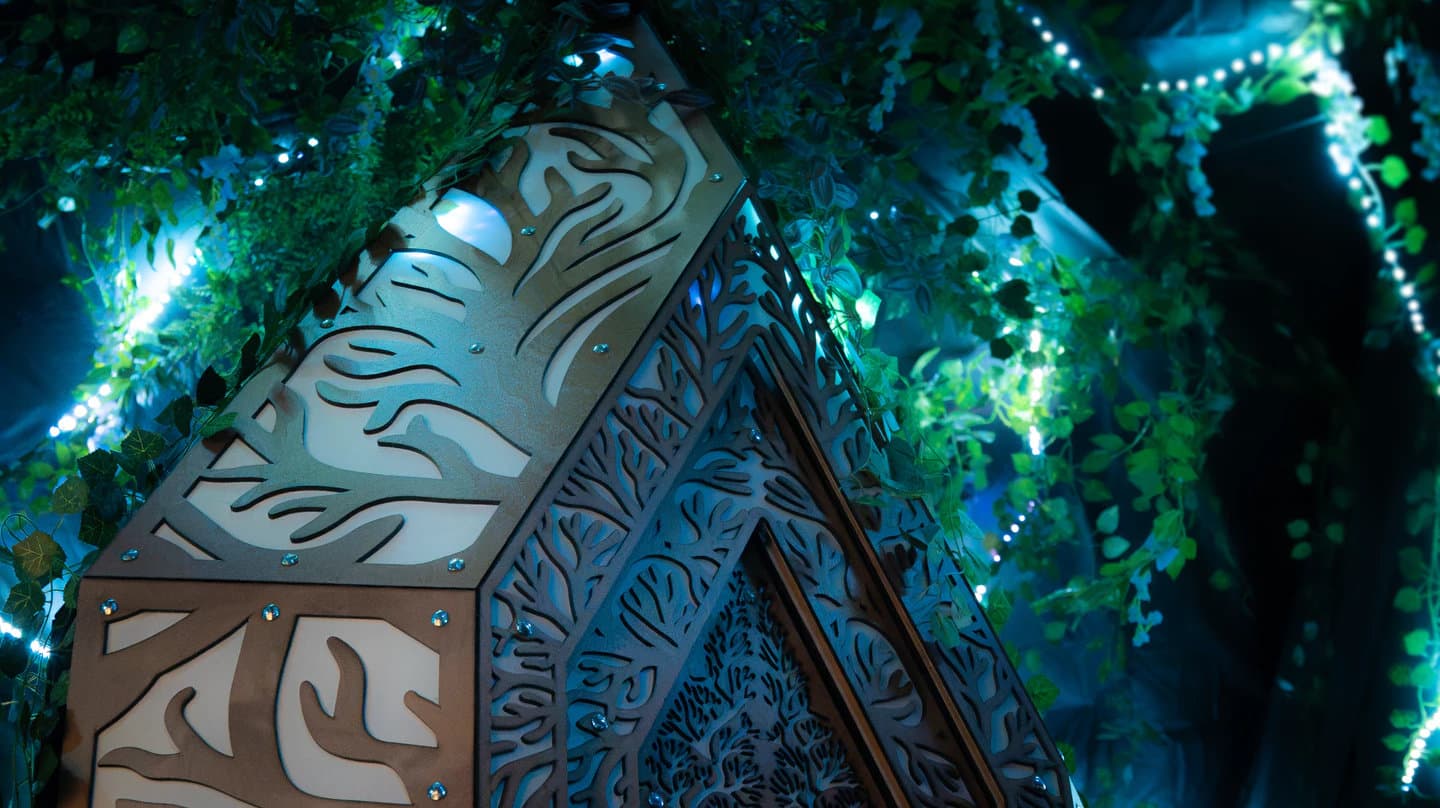
The process of building these artworks is pretty simple... on paper. The panels are laser cut in my workshop, the LEDs are glued in, and the whole thing bolts together so that it's easy to assemble on site into something that looks like it grew there.
Each crystal starts as a plywood "boat" — the structural hull that the LEDs get glued onto. The diffuser panels then bolt on top: laser-cut graphics with white fabric behind them. Olli designed the 3D shape of the boxes in Creo Parametric and I drew the cut graphics for the pieces in Mandala.cafe and Illustrator. The end result (cut files for laser) was put together in Rhino.
Everything locks together with DIN 603 bolts. They're square at the top so they lock in a square hole and then everything tightens up with wing nuts. Layers are separated from each other with 10mm nylon spacers I bought by the thousands for these projects.
The material is 4mm 5-ply A/AB birch from Koskisen. It's super good stuff: stiff, easy to cut, and the wood grain is gorgeous when it's stained and lacquered. We used water-soluble powder stains and semi-matte polyurethane lacquer (Helo 20). I cut everything on a 60W Trotec with a 1300 × 1300 mm cutting area that I got off an auction in spring 2022. I love it because standard full-size 1220 × 1220 mm plywood sheets fit in, and I don't have to touch the table saw.
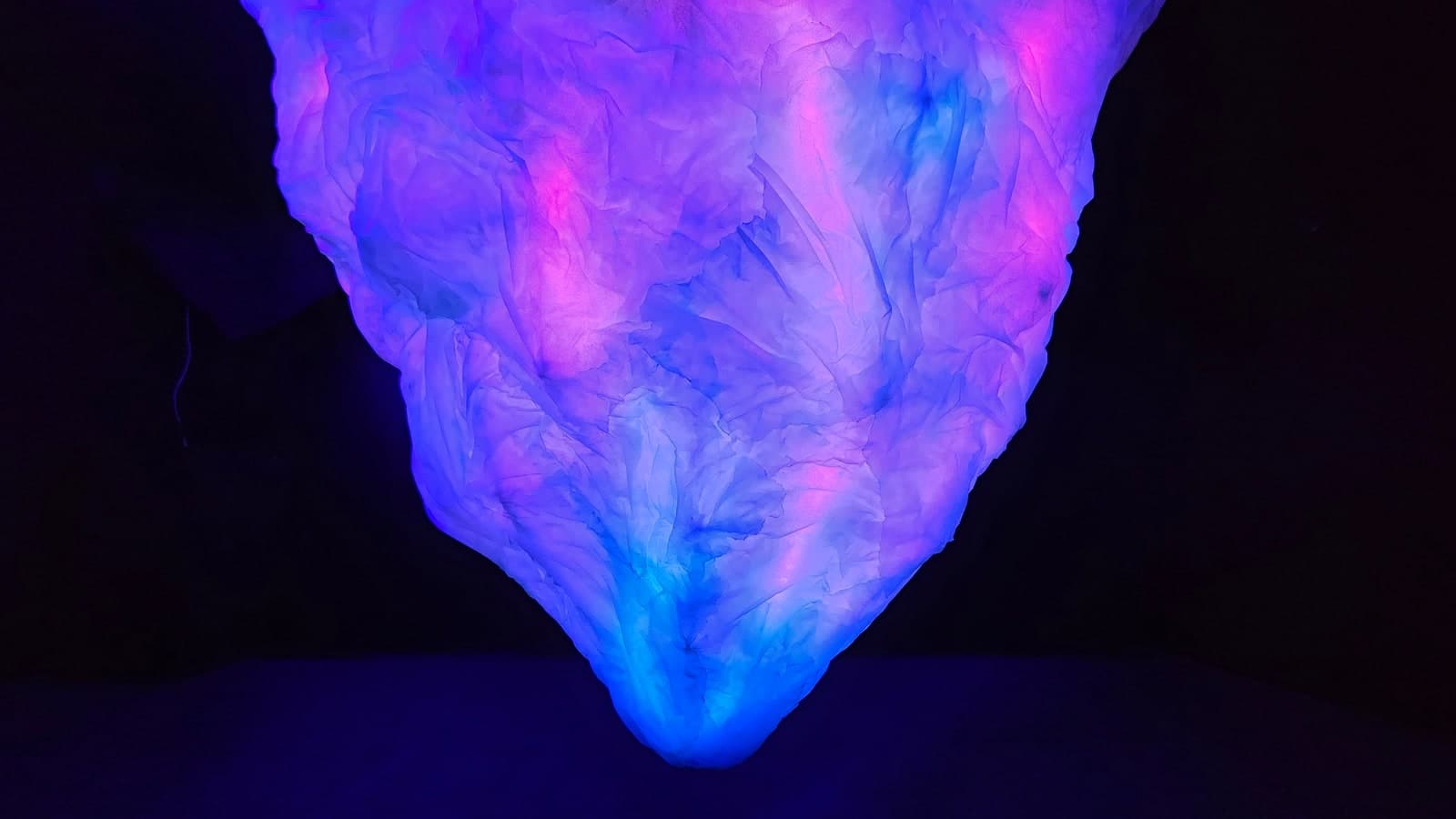
We used a white fabric as a diffuser for this year's deco. Turns out 1300 LEDs inside these 180cm (6ft) tall boxes is so bright that it completely drowns out the 17K lumens of projector light that we had on top of it. The previous year we couldn't see the LEDs on during the day at all. This year the artwork was very bright even during the day!
The entire build took us six 12-hour days for the four of us. It's always one of the best weeks of the summer. An art camp in my workshop in the countryside with a handful of my best friends, what's more to life than that? 😄
Ida's wall
There was also another LED artwork this year: four meters wide, one meter tall, made by Ida. It was installed on the front side of the FOH we built last year. Same recipe as the crystals — white fabric as a diffuser, spray glued to stacked, stained and lacquered plywood cuts. Seed pixels in 2.5cm (1") pitch, 400 pixels per each of the four panels, and one new WLED box running the whole thing.
This was the first piece by Ida, and it blew me away how cool it looked, even with relatively few LEDs compared to the crystals.

Power and data
Three generations of controllers ran the stage this year.
The five crystals ran on older hardware and some WLED controllers. These older controllers have 12 XLR outs, each outputting 12 V, ground and data. Each out is behind a 5 A fuse in a 12 V 100 A boat fuse box. Inside the 2U rack case there are 2 × 25 A Meanwell power supplies and a Club Lights 12 Pro from AliExpress, a $150 controller that runs 12 outputs. I've made XLR-to-xConnect adapters so I can hook up my LEDs and extension wires to the controllers. I also have a couple of controller boxes with larger power supplies up to 16 A for four outs, with an H802RA as the controller.
Check out my WLED controller build guide!
The FOH wall and the environment strings ran on the new generation: four WLED boxes I built this spring. They're super clean, small, waterproof and easy to install. The whole bill of materials lands at about 80€ per box:
| Part | Price |
|---|---|
| AliExpress IP hard case | 13€ |
| Gledopto Elite 4D-EXMU controller | 25€ |
| Meanwell XLG-150-12-A power supply | 28€ |
| Ethercon feedthrough (Rean RRE8F-Z-000-1) | 5€ |
| xConnect & power wires, rubber gaskets, wagos | 5€ |
Each box drives 4 outputs at 60 fps, 3 universes (or 510 LEDs) per output, and each output is plenty bright when the string gets power from both ends. So, 2048 pixels in total per controller. The WLED controller has an ethernet port - never use wifi when ethernet is an option during festival shows. Everything might work fine until the gates open, and suddenly the wireless channels are filled with noise.
I love the fact that the WLEDs are very configurable. Their IP addresses are completely flexible, unlike the AliExpress boxes. And they can fail more gracefully - they can be set to fall back to their own onboard programs if needed. I setup all the WLEDs to run dark on start so if there was a connection problem, that artwork would be dark instead of a random, bright color.
Everything connects with xConnect. I love the large plugs. Sometimes there are deformed plastic parts in orders, but it is still by far the best connector I've used for these.
The null pixels allow for longer data runs. I have 3m and 6m extension cables for the LEDs, and I use these data extenders always above 6m runs.
Load-in
On site, the whole thing comes together in three days. The lower artworks were easier to install thanks to the truss rods we installed on the lip of the stage. Regular truss hooks and super clamps are cool, if you just have a good attachment spot for them. We still need to figure out better ways of attaching our artworks to the stage, I'm not quite happy yet.
Mapping seven thousand pixels
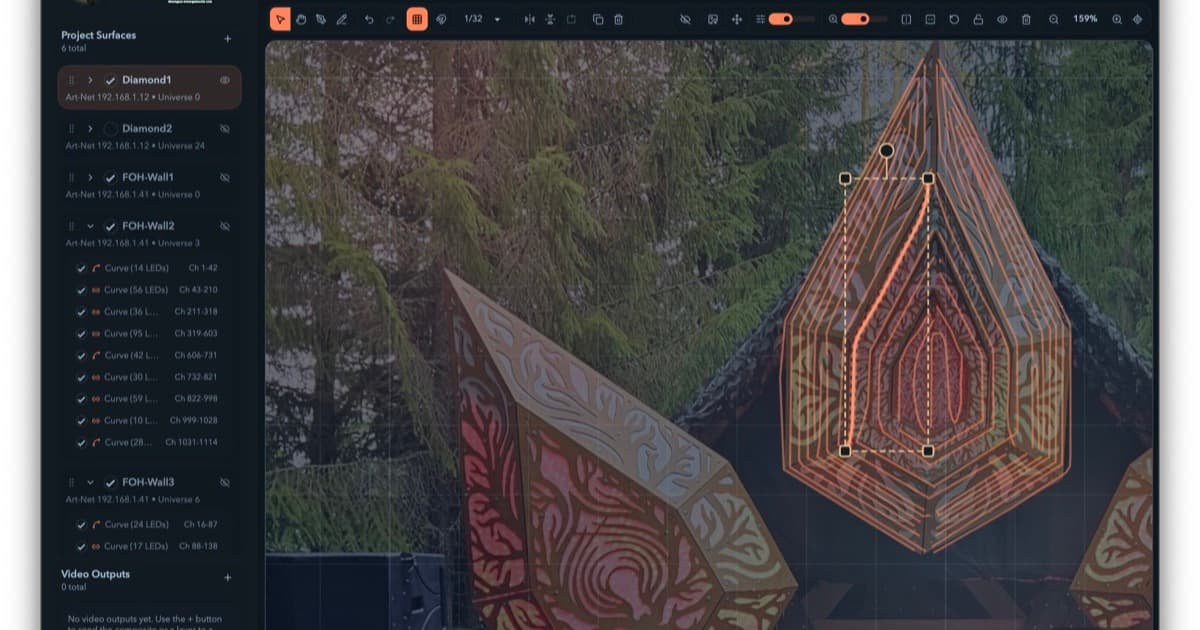
The whole point of Filament is that mapping starts from a photograph. You load a photo of the actual rig behind the canvas, trace each LED run as a curve, tell it how many pixels are on that run, and it spaces them along the curve and assigns the DMX channels in sequence.
So we shoot photos like these on purpose: LEDs on, straight-on angle, before the diffusers close everything up. They go straight into Filament as tracing backgrounds.
For a stage like this that matters more than it sounds. The panels aren't grids — the LED runs follow the cut patterns in the plywood, they curve and loop and double back. Tracing an artwork over a photo takes less than 15 minutes in Filament, and when something looks wrong you can see where it's wrong, because the map looks like the stage.

I like to use wifi while mapping, so I can walk around the area with my laptop and map all the lights, and then run everything wired ethernet in production.
Show nights
Content was created in Filament, TouchDesigner and Resolume, routed to the main video mixer computer via NDI, and eventually mapped with Filament and Resolume to LEDs and projectors, respectively.
The Player in Filament is a clip grid: layers stacked on top of each other, blending into each other.
One machine runs Pulse by Hybrid Constructs, which extracts a running bpm and shares it to other machines on the local network. Ableton Link keeps the motion on the beat in Resolume and Filament. We had one network between the computers and a separate network from my machine to the LED controllers.
I've been blessed with incredibly talented, good friends, so working at Kosmos together is always a nerd's wet dream. Multiple computers producing different kinds of sick generated and pre-rendered content, routing it between machines and finally mapped with dedicated hardware. Low latencies, beefy hardware and a setup of midi controllers that looks like airport traffic control. A couple of years back Tomi's computer had a flight simulator throttle bolted to the wall to control the overall speed of visuals! 😁
Tomi's master mixer and video mapper computer sent me a master video via NDI, so I could run the master and mix it with my own stuff in Filament. For three nights there were 2-4 VJs running the show at all times.
What broke, what held
I've always been a little nervous before the festival due to unreliable hardware, questionable chinese led strips and power supplies, and software glitches. This year felt different. I had redundant hardware in case of problems, and I knew the software end to end — I wrote it, and I'd already fixed everything the spring gigs threw at it.
The only problems we had were obvious in hindsight: Two of the seed pixel strips in the trees were missing their o-ring for waterproofing, which caused some glitches on the first night after some strong rain. After that was fixed, everything was smooth sailing.
And it's funny. We run this crazy pile of high-tech stuff: generative content, projection mapping, multiple machines synced to a shared clock — really abstract, conceptually difficult stuff. And then the worst problems of the weekend are the most low-tech ones imaginable: this one bolt in the projector frame just does not open, and that takes 30 minutes from four people.
So how was it?
8 hours per night, 3 nights in a row, with no dropped frames and solid 60 fps. It was super fun! Our dear friends of Skipper Alley Pirates and Konna did an awesome job decorating the inner part of the stage and running the lights. There's something quite magical about trees being washed with color lights, creating sharp silhouettes against the darkness of the forest.
I enjoyed the hell out of this project once again. Kosmos Festival is a super cool festival with a mindblowing amount of art and culture. I've been lucky to be here from the start, and there's much more to come.
If you have LEDs of your own - a strip on a shelf or a festival stage - download the program now. No signup, no time limit: map your rig, route your controllers, play around with it.
festival-report · behind-the-scenes