September 10, 2026 · Hexagon Intergalactic
ITU: Plywood sculpture & LED light show and installation
Two plywood crystals, a room full of vines and LEDs, and a custom soundtrack made for our first independent exhibition at Galleria Myötä in Helsinki.
I work with an artist collective called Kiva. That's Finnish for "nice". Kiva is currently eight people. Four of us worked on this exhibition: me, Elina, Olli and Ida. We called it ITU, which means sprout in Finnish. It ran from 14 - 29 August 2026 and was our first independent art exhibition.
We make stage decorations for Kosmos Festival. This summer we had made five plywood crystals for the stage, and I thought they were so cool that I wanted more people to see them. You can see the original stage and crystal build in the Kosmos report.
We had already talked in Kiva about putting two of the crystals together back-to-back. After the festival I got this vision of a hanging diamond with tons of greenery and LED lights sprouting from it, spreading up to the ceiling and all around the room.
I was supposed to do a solo exhibition at Galleria Myötä in Kallio, Helsinki. But I got excited about this idea, asked the rest of the group whether they felt like doing it together, and they were up for it. From that decision we had two weeks before the build and three weeks before opening the doors. A pretty tight schedule for turning the idea into an entire room.
Some very artificial vines
For years I'd wanted a proper reason to buy a lot of plastic greenery and make decorations with them. Now I suddenly had the perfect opportunity. The plywood crystals already had these lasercut, filigree-like organic patterns, like roots and branches, so the vines felt like a natural next step. I spent the next couple of days browsing Alibaba and AliExpress, trying to find good-looking fake vines and flowers.
In the end I ordered about €150 worth of greenery: a few hundred meters of vines, purple flowers and some ferns, about five different types altogether. The vines turned out to be so thin that we had to bunch four or five together to make one that looked decent. A few hundred meters sounds like a lot until you start doing that.
We already had the LEDs from the summer, but the black molton fabric from Thomann and the artificial greenery were ordered for this exhibition. Both arrived only a couple of days before we had to start building. The plants had a pretty gnarly plasticky smell, so I opened all the packages and spread them out on my porch to air out. Luckily, it worked. No plastic smell bothered us during the buildup or the actual exhibition.
Taking over a small room
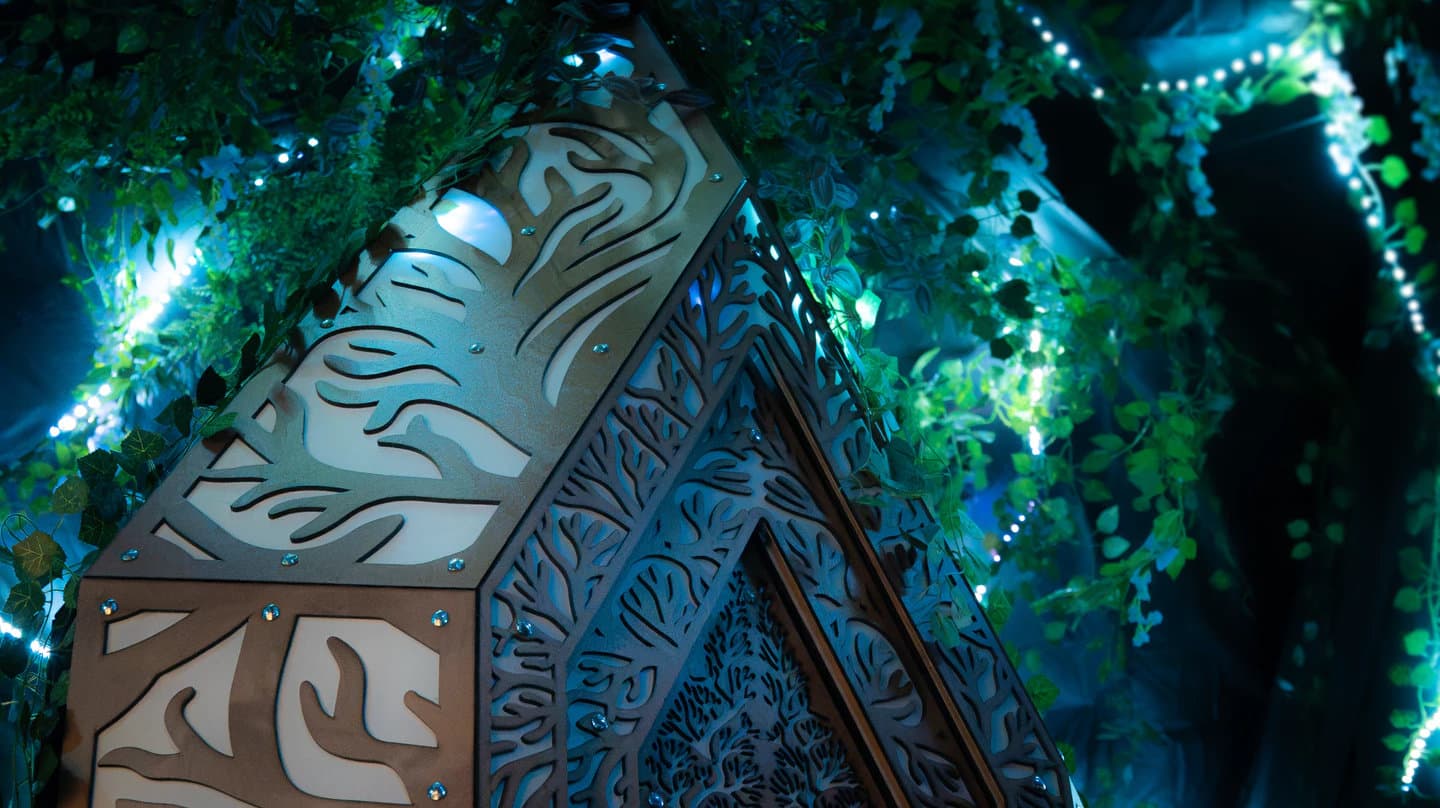
The exhibition room was only about 2.5 by 6 meters, much smaller than most galleries I've been to. Into that we hung a plywood "crystal" about 1.8 meters tall, with vines and lights growing out of it into the ceiling, across the walls and down. Like a large plant machine thing that had overtaken the room.
Putting the two identical crystals back-to-back gave us a piece you could walk around and inspect from any angle. We tilted it slightly so that the best view was from near the doorway and next to the wall where the bean bags and chairs were. You come into a dark room through the fabric-enclosed doorway and there it is, hovering in the air, with the soundtrack moving around you and the lights pulsing and shimmering with it. The result was very close to the original picture I had in my head: something large and imposing, floating like a sci-fi gadget, but still very organic.
At Kosmos I'd already had this feeling looking at the stage... It woke up a kind of reverence in my chest, like I was witnessing something larger than just us humans. Several visitors described ITU as church-like, or said it gave them a feeling of something sacred. I recognised what they were talking about. Judging by those conversations, that feeling had come through quite well.
Building the gallery first
This was also Galleria Myötä's first exhibition. It was nice to start a new gallery with a bang, but it meant we had to spend the first couple of days building some of the infrastructure before we could really get on with the installation.
Six-meter-wide lengths of molton fabric are quite heavy. We installed plywood rails along the tops of the walls so we could hang the fabric, and put in the large ceiling hook for the crystal. The idea was that the hanging infrastructure would also be there for future exhibitions to use.
First we had to make some hardware work drilling holes and installing the hanging points for the fabrics. Putting the crystal together was fortunately quite a simple task of low-tech engineering. Both halves already had a wooden cross on the back. I cut a couple of small plywood blocks that we could screw the halves together with, then we covered the crystal's seam with black fabric and wrapped vines around it.
Getting it up
Lifting the assembled crystal was awkward because the only places you could really get hold of were the laser-cut diffuser panels. It's a bit like picking up a painting by the painting itself instead of the frame. The ceiling attachment, on the other hand, was something I wasn't worried about. The chemical anchor we used listed a load capacity of around two tonnes, and we'd put the work into that fixing before hanging the crystal from steel wire. I wanted that part sorted properly so we wouldn't spend the exhibition wondering whether the thing would stay up.
Such shrubbery
Elina and Ida arranged the plants and LED strings on the ceiling and walls. We'd talked through the idea together, including how I saw the light traveling out of the crystal, and agreed on a common plan. After that, the actual arrangement was up to their artistic eye. This is why you need competent friends you can trust. I barely had to think about the vines and lights because I knew they'd do an excellent job, which left me free to focus on the mapping, the light show and everything else on my side. And, of course, the software that ran it.
Monday and Tuesday went into getting the room ready. Wednesday and Thursday were mostly plants and lights, and I spent Thursday mapping the LEDs and building the composition I'd planned. We got everything finished on Thursday, if you count going to bed at about 5:30 on Friday morning as Thursday. Everything was working before we went to sleep, so in my books that's a success.
Four days playing with synthesizers
I'd never composed a soundtrack for an exhibition like this before. I spent around four days in FL Studio and had such a blast playing with the synthesizers.
I bought Fruity Loops 3 back in ~2002. If I remember right, it cost about €65. With the lifetime free updates, I'm still using FL Studio now. That policy is also why Filament has lifetime updates. I'm old enough to remember when you owned the software you bought, so subscriptions are out for me. A man has to have some principles.
During Covid I'd bought a ton of software synthesizers and samplers, and had been waiting to properly get my groove on with them. For this soundtrack I used Absynth 4, Massive X and Pigments for most of the synth work.
Everything started with the rain and the birds. They set the mood for the piece, and the mechanical clicking sounds followed quite quickly. I wanted the thing floating in the room to feel half organic, half mechanical and entirely otherworldly. That gave me a direction to explore with all those instruments.
At one point I was sitting in the studio laughing by myself, thinking how blessed I am with great hobbies and exciting things to do. It's so cool to be able to make music and then make a light show for it, in a room you've helped build, using software you've made. There's such a wide range of artistic expression in that. What's better in life?
From calm to chaos
The soundtrack became a loop of 10 minutes and 29 seconds, with three parts. The first is quiet, with ethereal piano reverberating in a large space and rain and birdsong in the background. Sometimes the rain comes in harder, and sometimes it fades away again. The lights shimmer with the piano notes.
In the second part, the seed crystal gathers energy. A riser builds in the soundtrack until it ends in a loud boom, with sparks and energy flying out of the crystal and into the vines around it.
The third part gets more atonal, crunchy and buzzing. A bit like a thousand angry mechanical bees. There are off-kilter crackles and mechanical whirring noises. It still feels beautiful to me, but also otherworldly. After another crescendo it slowly quiets down, the rain and birds return, and the piano comes back in until we're at the beginning again.

The burden and joy of figuring out the entire audiovisual concept
It's wild how much having the visuals in the same room changes the experience of listening to the soundtrack. Some sounds were suddenly much more in your face, while others seemed more hidden than they had in the studio. It got me thinking about how much each part needs to do when several senses are being tickled at the same time. It was easy to make the soundtrack too crowded. With the lights and sculpture there as well, it didn't need to be so intensive all the time.
When I made it sparser, it had more time to breathe and linger. The quiet beginning also gave the second part somewhere to go, so by the time it reached that peak, it felt really intense. I could make those decisions while playing the soundtrack straight from FL Studio through the actual exhibition speakers, with the installation around me. That's quite special. Usually, when you mix music, you have no control over what people will listen on or what their room sounds like. Here I could finish the mix in the exact space it was made for, without that guesswork.
I changed the soundtrack and the light show a couple of times during the exhibition, adding a little to parts I thought were lacking. That fitted the sprout theme quite well. Growing as it goes.
Mapping the crystal and the vines
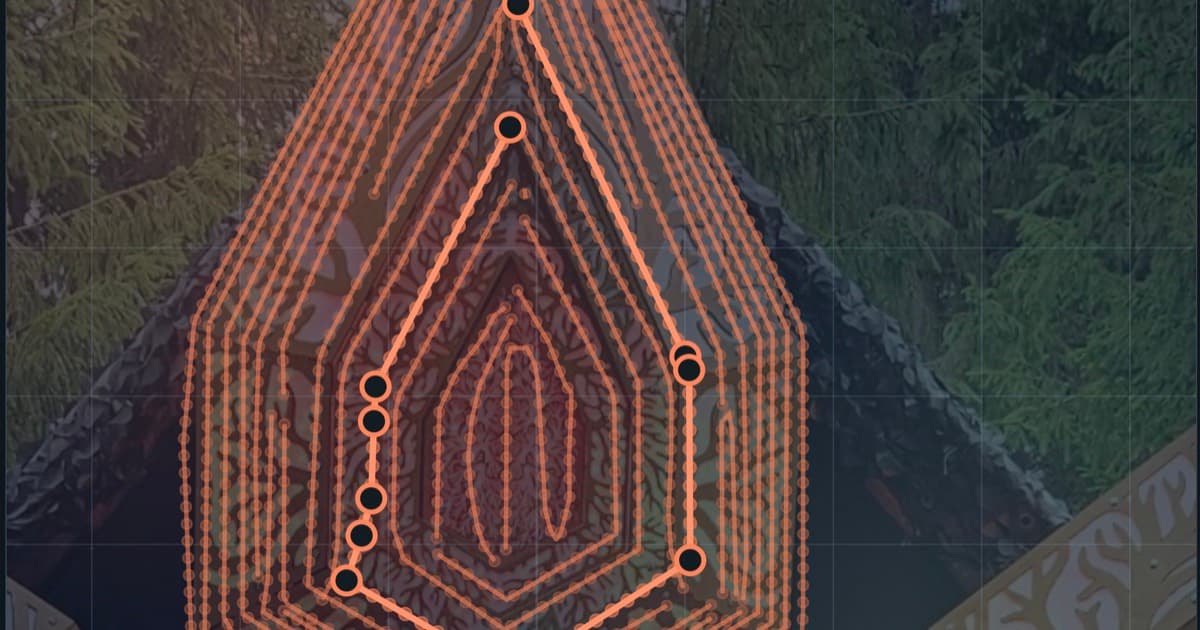
The whole show ran in Filament, the LED and video mapping software. The crystal layouts were already in my artwork library from Kosmos, so importing them was easy. I made the two sides show the same image, with one flipped so the content mirrored properly and met cleanly at the seam.
For the LED strings spreading through the room, I used a much simpler layout. On the map they were long, straight lines starting from the bottom centre and fanning out towards the top. Physically they were winding through the plants, but this arrangement let me send expanding circles through the lights in a way that worked nicely in the room.
All the strings came out of the top of the crystal before spreading into the ceiling. With light moving along them, we could make it look like the crystal was drawing energy from the plants and walls, or sending it back out into the room.
More tech-no-logia
The hardware was a MacBook Air connected through a dock and router to a network switch inside the crystal. From there the network split to four WLED controller boxes. Two ran the crystal, one for each side, and the other two ran the surrounding seed-pixel strings through eight outputs.
Those eight outputs each ran one string of 12 V WS2811 pixels at 2.5cm (1") spacing. The strings were five meters long with 200 LEDs each, and some had another hundred pixels added to reach seven and a half meters.
All the controller boxes, the network switch and the rest of the hardware were fastened with zip ties inside the crystal. Once we'd closed it up, we couldn't get at any of them, so the boxes and cables needed to be properly in place before that. I could still change the WLED settings over the network. A hardware failure would have been a much more annoying job.
Controlling regular DMX lights with Filament
We also had two RGBW PAR lights for ambient light. Without them, the room would have been pitch black whenever the pixels went dark, which didn't seem ideal for a public gallery. We put them in the far corner pointing upwards, spreading light through the room without shining into anyone's eyes. They also cast these cool shadows from the vines. During the build we often found ourselves choosing the subtler option, and a little light from the PARs did a lot here.
The PARs connected through a DMX controller. I set them to four-channel mode, using Filament's built-in RGBW fixture preset, and patched them one after the other on channels 1 and 5. In the map they were just two points beside the crystal, taking their colours from those spots in the composition. Mapping those was about a five-minute job.
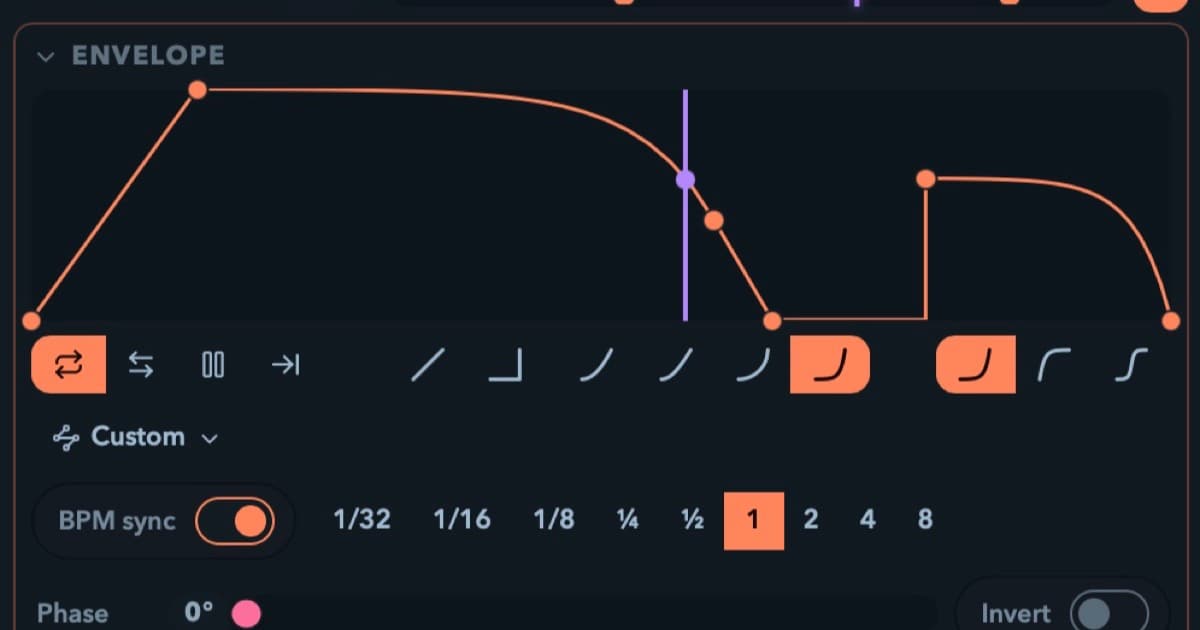
There were no rendered videos in the show. It was a saved composition playing in Filament, using the built-in animations and effects. I made one tweak to the Rising Sparks generator for this piece; otherwise it was all stock generators.
Visitors could move around the installation, sit down or lie on the floor. Usually people stayed for at least one or two loops, so it didn't matter much where they came in. Occasionally, when the room had been empty and several people arrived at once, I'd restart it for them.
Glowing feedback
I've been to so many gigs and parties that making an installation where someone can really sit down and take it in for a while feels somehow more precious to me now. There's still a lot of overlap with building festival stages; at its best, a stage can be something large and mesmerising too. At the gallery I could stay there, say hi to everyone who walked in and see how they spent time with the work. That was really special.
There was a Japanese family, a mother and three teenagers, who spent maybe forty-five minutes lying on the floor and the beanbags, just vibing. Quite a few other people stayed for a long time too, some for almost an hour. That's the best feedback.
"Can you make it go boom again?"It's funny how some really young kids would completely ignore the big shining crystal in the middle of the room and just be fascinated by the stickers on the table beside the door while their parents were transfixed to the crystal.
The response was so enthusiastic. Pretty much everyone who came in had something good to say, and the guestbook filled up with one glowing review after another about how relaxed and mesmerised people had felt. Some visitors also left a bit of their own art behind. Here's my favourite spread. 😁
At night I turned the sound off and opened the curtains so people could still see the installation from outside. As the whole neighborhood is a bit like Helsinki's red light district, there were quite a bit of massage parlors as neighbors, so our lights in the window looked quite different to theirs. 😅
Two weeks at the gallery
The soundtrack didn't get on my nerves nearly as much as you might expect. It only played for a few hours a day, and it was relaxing and sparse enough that I never got too tired of it.
I, myself, did get tired, though. I was staying in the back room on a sofa bed for three weeks total. There was no shower, so I went to the gym to work out and shower. I hadn't really understood how much energy it takes to keep a public place open for several hours every day, with strangers coming and going, for two weeks straight.
When the exhibition ended and I got home, my ears were ringing with the social energy of those three weeks. I needed some silence. I hadn't quite realised how tired I was until it was over. I slept for a few days.
Back to the workshop
Taking everything down only took a few hours. It's always like that. Building a set takes many times longer than tearing it down. Everything was reusable, and the crystals are now back on the walls of my workshop. The plants are mine too, so that pile of greenery will be coming out again for future installations.
We're already planning to take this same installation a step further. I'm fantasising about a large greenhouse or a botanical garden in Helsinki, somewhere we could make a bigger version of this thing. This was our first independent exhibition, and for me it was a resounding success, even with the exhaustion at the end. I feel like we lit a flame under a pot with this. Something's cooking already!
If you want to dig into the build, the Kosmos Festival report covers how we made the crystals and first used them on stage. I've also written up how I build my waterproof WLED controller boxes, with the parts list, wiring and settings.
And if this got you thinking about something you'd like to make, download Filament and try it with your own lights. It's the same software I used to map and run the whole ITU show. I'd love to see what you do with it.
installation · behind-the-scenes